We hear you, but...
A Letter from Ohio Democrats to Our Republican Neighbors
Last week we heard from Republicans in our rural Ohio Sentiment Model™ telling us why they just can’t listen to Democrats. I had many comments saying we can’t put our democratic values aside in order to placate Republicans. I agree. Today I thought I’d like to hear a response from the Democrats in the study. Here’s how they replied.
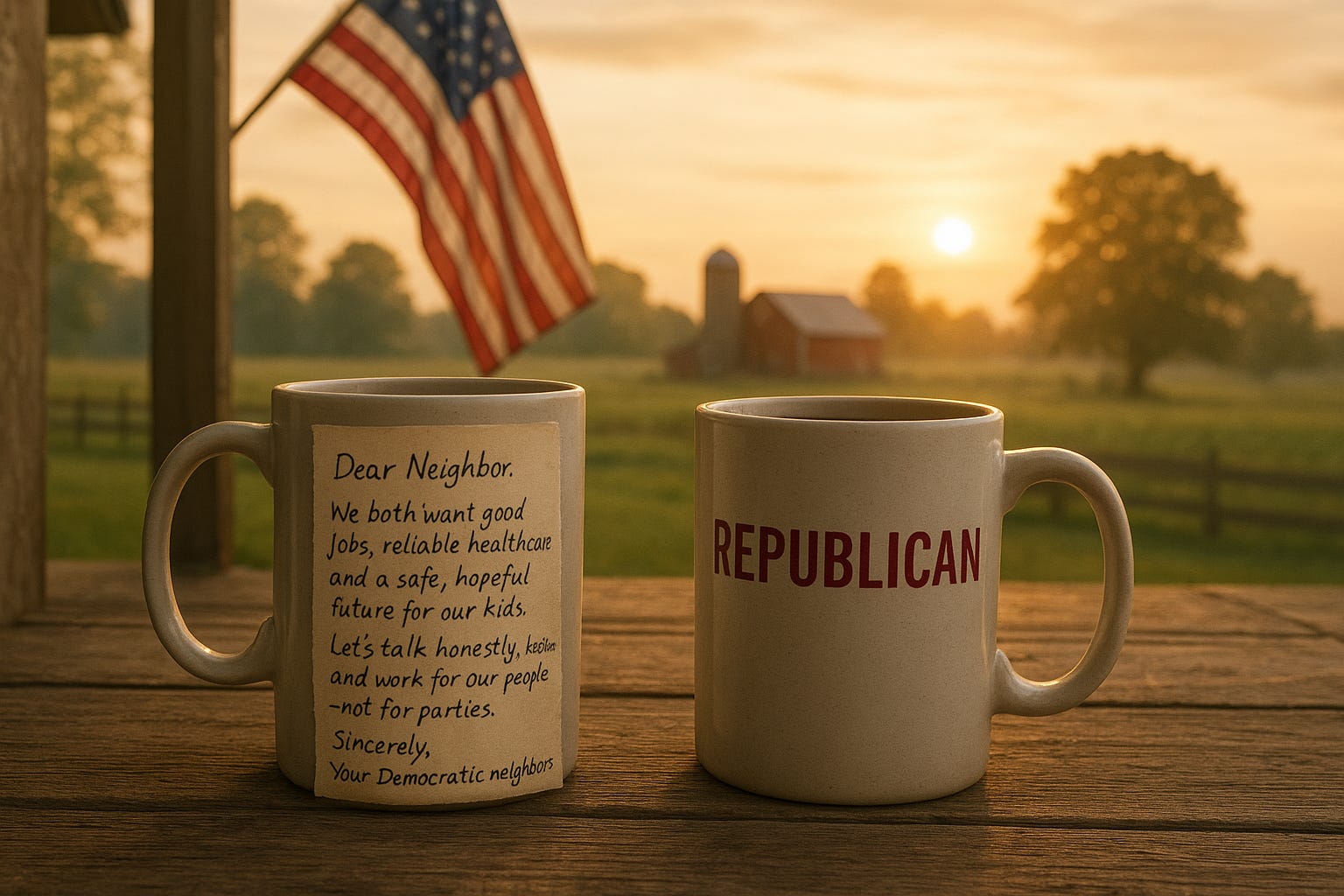
Dear Friends, Family, and Neighbors,
We’ve read your letter with care and reflection. We want to start by saying thank you—for your honesty, for the trust it takes to share frustration and vulnerability, and for your willingness to name the real divide that so many of us feel in our communities today. Many of us have shared meals, stood shoulder to shoulder at little league games, worshipped together, or worked side by side in the same factories, schools, and fields. Even now, as our political identities feel farther apart than ever, we have far more in common than what divides us.
Your words cut to the core of what so many are feeling: a sense that you are no longer heard or understood; that decisions made far away do not reflect your needs, priorities, or values; that a way of life built on hard work and independence feels increasingly threatened or dismissed. These are not small complaints—they are deeply felt, and we respect their importance.
We cannot respond to every line of your letter with a simple “yes,” but we can promise you a response that comes from just as much sincerity and care. We hope you’ll read these words in the same spirit—with an open mind and a willingness to consider where we might walk forward together.
On Listening and Being Heard
You tell us that you feel unheard—that policies are made in distant cities, by people who don’t know your lives, and that when you raise concerns, they are dismissed or minimized. We believe you. We also know that many Democrats, too, have felt silenced in their workplaces, families, or communities—afraid to speak up for fear of being misunderstood or insulted. We recognize the courage it takes to express frustration and to risk being vulnerable.
We want to be better listeners. We want to show up in your towns and homes, to drink your coffee and hear your stories. We want to participate in community meetings, not just when there’s an election, but because our democracy is built on relationships, not just votes. We want to bridge the distance between policy-makers and the people most affected by those policies. If we have failed to listen, or if our voices have overwhelmed yours, we offer you our apology, and our renewed commitment to do better.
But listening, for us, also means sharing our truth. Many of us grew up in the same places—rural towns, small communities, working families. Our grandparents farmed, our parents worked in the trades, our siblings serve in the military, our neighbors volunteer at the food pantry. Our politics are not imported from somewhere else—they are shaped by the same fields, churches, and main streets that shape yours.
On Work, Dependence, and the Meaning of “Help”
You tell us that you value hard work, that you want policies to reward effort and initiative—not to create dependence. We value that, too. We know the pride that comes from a long day’s work, the satisfaction of providing for family, the strength that comes from overcoming hardship.
But let’s be honest: sometimes, even the hardest working people fall on hard times. A layoff, an illness, an accident, a drought, a closure—these are not punishments for laziness or bad choices. They are the realities of life in America, for farmers, factory workers, and small business owners alike. When we support social programs—food assistance, unemployment insurance, Medicaid, Pell grants—it’s not because we want people to live off the government. It’s because we’ve seen how a safety net can give families a bridge, a chance to recover, and a path back to self-sufficiency.
We don’t want a system that keeps people stuck. We want a system that stands beside people when they’re down, and helps them stand on their own two feet again. We believe that investing in people—through job training, education, child care, and access to health care—makes our country stronger, not weaker. We believe that “help” is not a dirty word, and that in a nation as rich as ours, no child, no elder, no worker should go hungry or untreated.
On Priorities: America First, But Not America Alone
You tell us that you want American families and communities to come first—that you sometimes feel that government’s attention is directed everywhere but home. We understand this. It angers us, too, when roads go unrepaired, when rural hospitals close, when schools struggle for resources, when small businesses are left behind. We agree that too often, national debates and spending seem disconnected from the realities of daily life in our own neighborhoods.
But we also believe that America is at its best when it honors its commitments—not just to its citizens, but to its values in the world. Part of what makes our country an inspiration is that we strive to help others, to welcome those in need, to share our prosperity and our ideals. We see immigrants and refugees not as threats, but as future citizens, neighbors, and contributors to our common life. We believe that strengthening America means investing at home and living up to our best principles abroad.
Prioritizing American families doesn’t mean turning our back on the world; and helping others need not come at the expense of our own people. We want to rebuild our infrastructure, revitalize our rural economies, and ensure that every community—big or small, city or country—shares in our nation’s promise.
On Small Business, Regulation, and Economic Life
You tell us that small businesses are being squeezed—by regulation, by taxes, by policies that seem made for someone else’s reality. We hear you. Thriving local businesses are the lifeblood of rural America, and we want them to succeed. We want to reduce red tape where it serves no purpose, and tailor regulations to fit the reality of small towns, not just metropolitan centers.
But we also know that some rules are there to protect workers, to ensure safety, to keep air and water clean, to guard against unscrupulous actors. We don’t want government to smother enterprise—but neither do we want to go back to the days when workers had no protection, or when Main Street was vulnerable to predatory practices. The balance is hard to strike, and we don’t pretend to have all the answers. What we do believe is that the best policies are made in conversation—with small business owners at the table, lending their expertise and experience.
On Values, Tradition, and Change
You tell us that your values—fairness, faith, family, community—are dismissed or mocked. That when you express concern, you’re accused of bigotry or ignorance. That every issue becomes a fight about identity or ideology.
We cannot speak for every voice in the Democratic Party, but we can speak with respect for your values. We believe in family, in faith, in community. Many of us share your religious beliefs, your commitment to raising children with strong morals, your pride in heritage and tradition. Where we differ, it is not out of contempt, but out of a belief that respecting others—including those whose lives or identities are different—makes our communities stronger.
We believe in fairness, not favoritism. We believe that diversity is a strength, not a threat. We want schools that teach history honestly, businesses that welcome all customers, and communities where everyone can belong. We know that change can be uncomfortable, but we also see it as a source of innovation, resilience, and hope.
On Trust, Promises, and Accountability
You tell us that you’re tired of broken promises. So are we. Trust in government is at a low ebb, and we all deserve better. We want leaders who keep their word, who show up not just for photo ops, but for real, hard work. We want results—fixed roads, good jobs, decent health care, honest government. We want accountability for those who cheat the system, whether they’re politicians, corporations, or private citizens.
Where our party has failed, we own it. Where we have succeeded, we ask for fair recognition. We ask for the chance to earn your trust, not with slogans, but with action you can see in your community.
Finding Common Ground and a Path Forward
We know we will not agree on every issue. But we are ready to work together on what matters most: good jobs, affordable healthcare, strong schools, reliable infrastructure, thriving small businesses, community safety, and the future of our children.
Let’s rebuild the habit of talking to one another—not just at election time, but all year long. Let’s host potlucks, town halls, and service projects that bring us together. Let’s invite each other into our churches, firehouses, and community centers. Let’s argue, debate, laugh, and break bread together. Let’s refuse to give up on each other.
We are Democrats—but first, we are Ohioans, neighbors, and Americans. We want to listen, to understand, to serve. We want your partnership in building a future that honors our hardest work, our deepest values, and our greatest hopes.
We are still here. We are still listening. And we believe that together, we can turn down the volume of division, and turn up the music of community, prosperity, and trust.